DAY 9 / WEDNESDAY / MARCH 16
NATIONAL MUSEUM OF IRELAND
OVERNIGHT IN DUBLIN
Kilkenny, on the shores of the River Nore, is the finest medieval town
in Ireland and one known for its artisans. A flourishing civic, ecclesiastical
and government center for more than 1,000 years, it boasts splendid
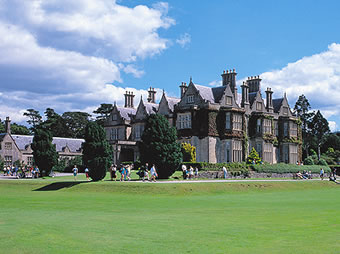
buildings, including the dominant
Kilkenny Castle.
Built in the 1190s by the Norman leader
Strongbow, Kilkenny Castle was
occupied right up until 1935. The powerful Butler family lived in it from
the late 14th century, but because of the exorbitant upkeep, their descendants
donated the Castle to the nation in 1967.
Kyteler's Inn, a medieval coaching inn, is named after Dame Alice Kyteler,
a 14th-century witch who once lived in the building. Like most of the pubs
in the city, Kyteler's Inn sells Smithwick's beer, which has been brewed in
Kilkenny since 1710.
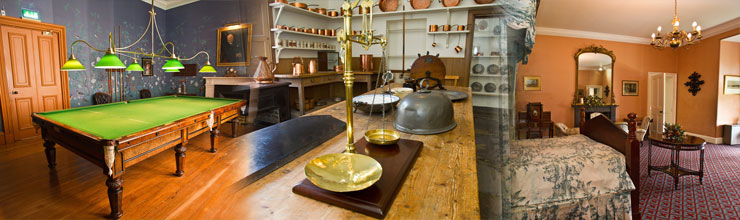
Kilkenny Design Centre, housed in Kilkenny Castle's stable block, has a
nationwide reputation. You can see craftspeople in action and also buy
their works.
Virtual Tour of Kilkenny
From Kilkenny, we drive to Dublin and visit the
National Museum of Ireland at Michael Collins Barracks.
The museum is home to a wide range of objects which include weaponry, furniture,
silver, ceramics and glassware, as well as examples of folklife and costume.
The exhibitions have been designed in innovative and contemporary galleries.
DAY 10 / THURSDAY / MARCH 17
ST PATRICK'S DAY PARADE AND FESTIVAL
OVERNIGHT IN DUBLIN
"The Saint Patrick's Day parade
through the Dublin city center streets is
an event not to be missed."
---Patrick O'Riley, Fianna Fáil
Until recently, St Patrick's Day in Dublin was celebrated with "just" a parade
through the city center on the morning of March 17th.
But in 1998 an entire
Saint Patrick's Festival was built up around the event, with all sorts of
activities, street entertainments, music, and shows. Year by year, the festivities
have grown. This will continue on an
even larger scale for the celebration in 2011.
A monster
ceili starts at 2:30 pm in St Stephen's Green: Irish dancing on a
massive scale. Join the
craic (that's Gaelic for "fun!")
We suggest an afternoon visit to
Trinity College to see its 1,200-year-old Book of Kells, the most richly
decorated of Ireland's medieval illuminated manuscripts, housed in The Long Room
in the Old Library, one of the finest library buildings in the world. Admission to the Library
is free of charge on St Patrick's Day.
The Chester Beatty Library is located in the gardens behind Dublin Castle.
The Library's collections are displayed in two permanent exhibitions: "Sacred Traditions" and
"Artistic Traditions".
The Sacred Traditions Gallery exhibits the sacred texts,
illuminated manuscripts and miniature paintings from the great religions and systems
of belief represented in the collections - Christianity, Islam and Buddhism with
smaller displays on Confucianism, Daoism, Sikhism and Jainism.
The Biblical Papyri,
the remarkable collection of Qur'an manuscripts and scrolls and books of Buddhist
thought provide the focus for the displays. Audio-visual programmes on Rites of Passage
in many faiths, prayer and pilgrimage enhance the displays.
The Artistic Traditions gallery is devoted mainly to works of art on paper,
techniques of print-making, binding and paper-making and the art of miniature
painting.
The display draws on the rich manuscript holdings, the collection of
rare printed books and of decorative arts, especially from East Asia. The exhibition
is introduced by a display devoted to the life and work of Sir Alfred Chester Beatty.
The Irish Museum of Modern Art presents contemporary and modern art by both Irish
and non-Irish artists. The museum is housed in the Royal Hospital Kilmainham, the finest
17th-century building in Ireland.
The Royal Hospital was founded in 1684 by James Butler,
Duke of Ormonde and Viceroy to Charles II, as a home for retired soldiers and continued
in that use for almost 250 years. The style is based on Les Invalides in Paris with a
formal facade and a large elegant courtyard.
The city comes alive at night with entertainment in the capital's pubs, clubs
and restaurants ... and in the streets.
O'Donoghue's Bar at 15 Merrion Row (not far from our hotel) is Dublin's most famous
venue for traditional Irish music with sessions every night. Tiny and cramped,
but ringing with joyous sounds of the harp,
bodhran, and uillean pipes,
O'Donoghue's sometimes has two groups playing simultaneously on both sides of the pub.
The Brazen Head at 20 Lower Bridge Street also offers traditional Irish music every night,
It claims to be the oldest pub in Dublin, dating back to 1198.
Other favorites for traditional music are (1)
Auld Dubliner at 17 Anglesea St,
(2) The Mean Fiddler and (3)
Whelan's , both on Wexford Street, and (4) Keating's
on the corner of Jervis St and Mary St.
For modern live music, try Mother Redcaps Tavern, Back Lane, Christchurch.
Theater lovers might want to take in a performance at the famed
Abbey Theatre .
O'Connell Street and the River Liffey in Dublin
DAY 11 / FRIDAY / MARCH 18
DUBLIN CITY TOUR
OVERNIGHT IN DUBLIN
Enjoy a sightseeing tour of the capital with a local guide, who will bring the
city's history alive.
The 18th century was
Dublin's Age of Elegance when the Irish gentry set about
remodeling the city into one of the most elegant in Europe. Terraced town houses
were built, forming handsome new streets and squares. Merrion and Fitzwilliam
Squares have survived, with some of Dublin's finest architecture.
Leinster House is a stately mansion which houses the Dáil and the Seanad, the
two chambers of the Irish Parliament. It was originally built for the Duke of
Leinster in 1745.
Dublin Castle, built between 1208 and 1220, represents some of the oldest
surviving architecture in the city, and was the center of British power in
England for over seven centuries, until it was taken over by the new Irish
government in 1922.
Once the seat of the Royal Exchange, the Georgian municipal building today
houses the city authority, called the Dublin Corporation. Twelve columns circle
the domed central rotunda, which has a fine mosaic floor and 12 frescoes
depicting Dublin legends and ancient Irish historical scenes.
Saint Patrick's Cathedral , Ireland's largest church, was founded beside
a sacred well where St. Patrick is said to have baptized converts around 450 AD.
Christ Church Cathedral, one of two Protestant cathedrals in Dublin, was built
in 1172 by a Norman,
Strongbow (Richard Fitzgilbert de Clare), whose remains
are buried in the cathedral, beneath an impressive effigy. It was restored to
its former splendour in the late 19th- century. The crypt is Dublin's oldest
surviving architecture.
Afternoon Free to Enjoy as You Please
Many have enjoyed an afternoon visit to the famed
Guinness Brewery. There are four floors of exhibitions and cafés.
The "Gravity Bar" on the top of the building provides visitors with a
commanding 360-degree view of Dublin.
The admission is 14 Euros (12.60 Euros, if booked online), which includes an audiovisual
presentation, a tour of the
Hopstore (admission to the brewery itself is not allowed) and
a drink of the dark brew.
If you are of a literary bent, Dublin will be a treat. It is the only European
city to be the birthplace of three writers who received the Nobel Prize for
literature in the 20th century -
William Butler Yeats,
George Bernard Shaw and
Samuel Beckett.
The Dublin Writers Museum , housed in two restored 18th-century buildings, has
exhibits which focus on these great authors, as well as James Joyce, Jonathan
Swift, Brendan Behan and Oscar Wilde.

W.B. Yeats
by John Butler Yeats (1900)
National Gallery of Ireland
Just steps from the Hotel Davenport are three excellent museums,
all free of charge to the public.
The
National Gallery of Ireland displays not only Irish artists, but virtually every school of
European painting.
The collection is considered one of Europe's finest, with more than 2,400 paintings, as well as
sculpture, drawings and prints. One could easily spend an entire afternoon here
(and then want more time for the excellent gift shop with its superb selection of
books, prints and cards.)

The Tara Brooch
The National Museum of Ireland,
opened in 1890, displays artifacts through
the ages, including the
Tara Brooch and the
Ardagh Chalice.
The Natural History Museum focuses on the zooligical aspect of Ireland's history,
with collections on wildlife.
Nearby Leinster House is the meeting place of Ireland's government. The office of the
Prime Minister is there.
DAY 12 / SATURDAY / MARCH 19
RETURN FLIGHT HOME